






















































RJ45 RJ11 plug
Filter
Sort by:

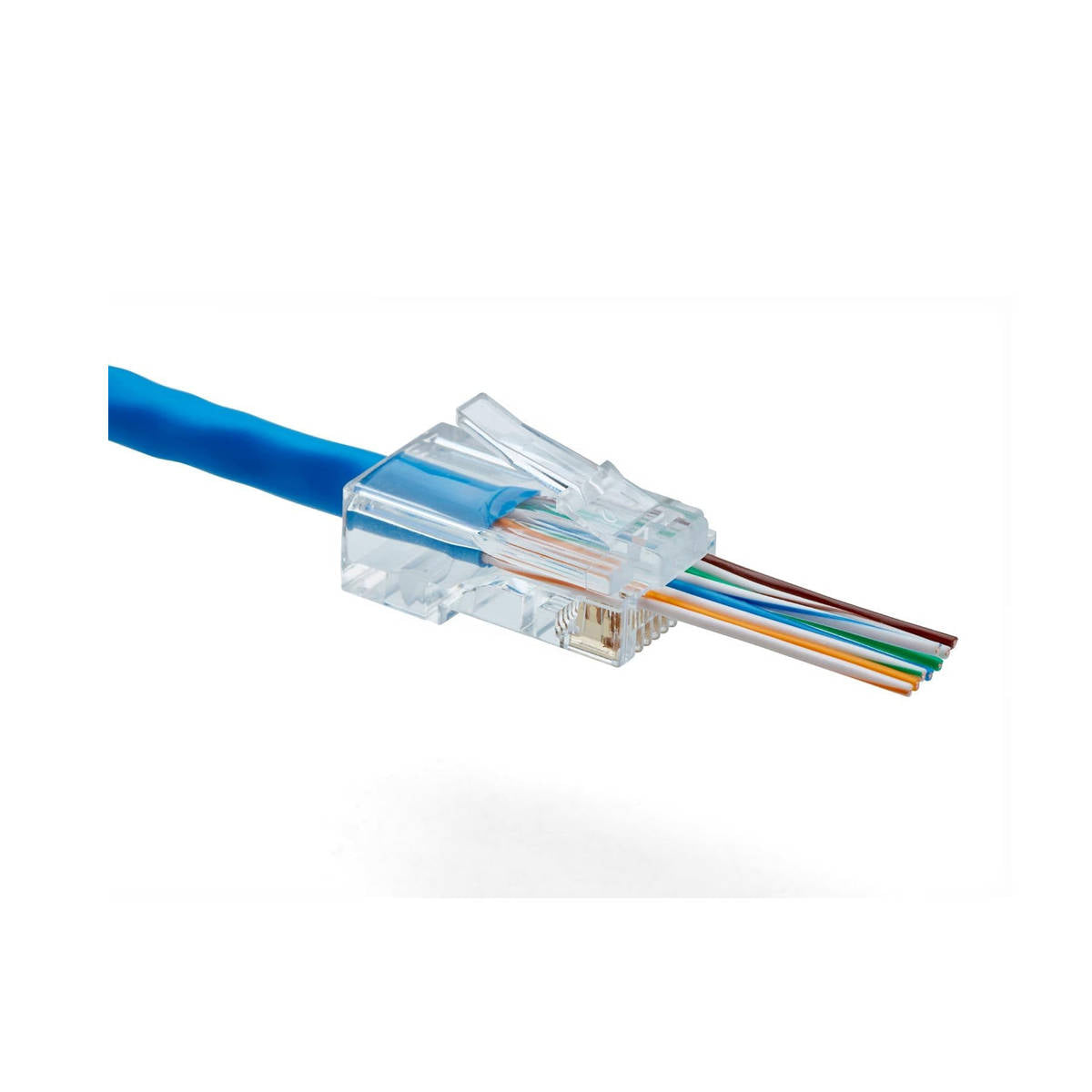


RJ45 plugs: pass-through or traditional, and for which cable
The plug is the connector that is crimped onto the end of a network cable. It seems like a trivial part, but three details determine whether the crimp holds or if the socket starts losing packets after six months: the category, the type of conductor it must accommodate, and whether it is pass-through or not.
Why pass-through changes the job
In a traditional plug, the conductors must be cut to the exact size before inserting them, and you cannot see if they have all reached the end: if one remains short, the contact is not made and you only realize it during testing. In a pass-through plug, the wires extend out of the tip, so you can see them, check the order of the colors at a glance, and only then crimp: the tool cuts the excess flush in the same motion. For an installation with many terminations, the difference in time and errors is substantial. However, you need a crimping tool with a blade for pass-through plugs: a traditional one does not cut the excess wires.
Selection table
| Cable to be terminated | Plug |
|---|---|
| Cat. 5e, existing installations and Gigabit connections | Cat. 5e 8-pin RJ45 plug, for solid and stranded conductors |
| Cat. 6, new wiring and higher performance | Cat. 6 8-pin pass-through RJ45 plug, for solid and stranded conductors |
The plugs in our catalog are sold in jars of 25 pieces: the right quantity for an installation, not for a single repair. Account for a few wasted pieces — even professionals make mistakes on their first few crimps.
Solid and stranded: why it matters
The blade contacts of the plug must pierce the insulation and bite into the copper. A plug designed for solid conductors has blades that embed themselves into the solid wire; one for stranded has blades that embrace the bundle of thin wires. The plugs indicated for both, like those in our catalog, have a contact geometry that works well in both cases: this is what you need when you have solid-core reels for fixed installation and flexible cable for patch cords on site.
Pro tip. Two errors we see constantly. First: untwisting the pairs too much. The twisting must be maintained right up to the plug — two centimeters of open pairs is enough to drop performance below the cable's category, and testing will reveal it even if it "technically works." Second: the sheath must enter the plug and be locked under the retention tab. If it stays outside, the tension on the cable goes directly to the conductors, and the termination will eventually fail. One last thing: use the same color scheme (T568A or T568B) at both ends of the cable, and throughout the entire installation.
Frequently asked questions about RJ45 plugs
Can I use a Cat. 6 plug on a Cat. 5e cable?
Yes, it works without issues: the performance of the line remains that of the cable. The opposite — Cat. 5e plug on Cat. 6 cable — limits the connection to the lower category and renders the investment in the cable pointless.
Do I need a special tool for pass-through plugs?
Yes. The tool for pass-through plugs has a blade that trims the conductors flush with the connector during crimping. With a traditional tool, the wires remain protruding and must be cut by hand, with the risk of leaving them misaligned.
What is the difference between T568A and T568B?
These are two different color sequences, both valid. What matters is using the same sequence at both ends of the cable: cables with different schemes at each end result in a crossover, which still works on modern equipment with auto-MDIX but makes the installation impossible to document properly.
Is the plug also suitable for shielded cable?
Only if it is a shielded plug, with a metal housing that grounds the cable's shield. On an S/FTP cable terminated with non-shielded plugs, the shielding remains disconnected and serves no purpose.
How do I know if the crimp was successful?
With a network cable continuity tester, which checks pin by pin. By eye, you check that all eight conductors reach the end of the channel, in order, and that the sheath is locked by the tab: if one of these three points is not correct, re-crimp.
See also crimping tools, ethernet bulk cable, and RJ45 keystones for domestic series.





