





















































Supports for Photovoltaic Panels
Filter
Sort by:


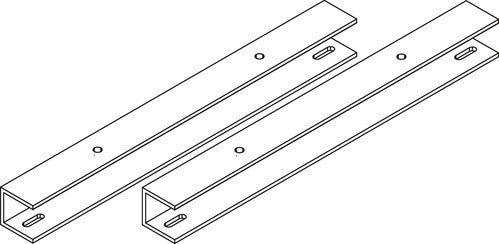

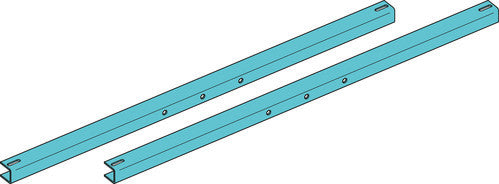

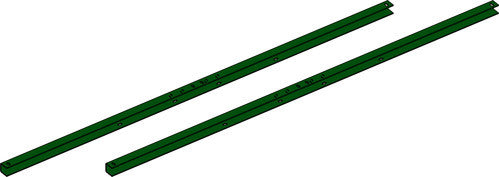



Photovoltaic panel supports: choose based on panel size
The support is not a generic accessory: it is sized for a power range, which corresponds to a range of measurements. A profile for a 50W panel cannot support a 180W module, and it is not just a matter of weight: the surface area exposed to wind changes, which is the most severe stress on off-ground structures. Therefore, before ordering, check the power of your panel and the type of mounting you need to perform.
Selection table
| Where you need to mount | Support |
|---|---|
| On an existing pole (lighting, camera, repeater) | Pole-top element, in versions for 15/27/50W or 70–180W panels |
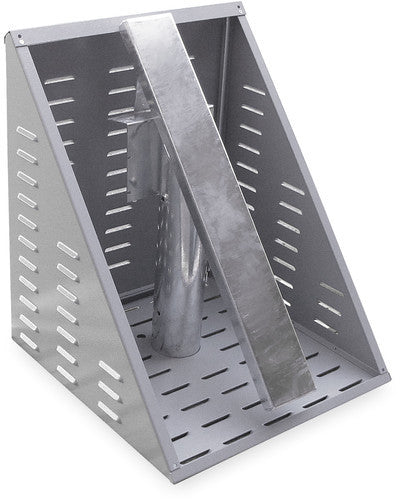
| On a pole, with battery to be housed at height | Battery-holding pole top for poles ø 80–90 mm |
| Floor or wall mounted, with fixed tilt | Pair of galvanized profiles or triangular brackets, depending on the panel size |
| On the roof of a camper or vehicle | Dedicated aluminum supports, lightweight and low-profile |
| On a balcony railing | Adjustable brackets for balcony photovoltaics |
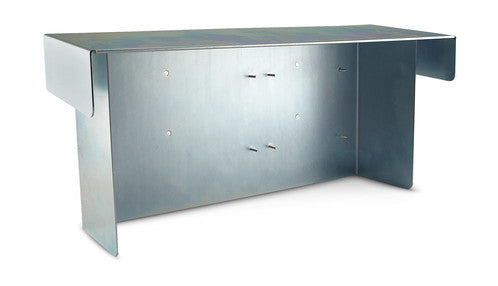
| Charge controller to be fixed near the system | Dedicated support for controllers |
Galvanized or aluminum
Galvanized steel is the choice for fixed installations on the ground, on a pole, or on a wall: it costs less, is very rigid, and the zinc protects against corrosion for years. Aluminum weighs much less and is what is needed where weight really matters, typically on the roof of a camper or on lightweight structures. In a marine environment, aluminum also performs better against salt air.
Tilt: how much it really matters
A tilted panel produces significantly more than one laid flat because it receives radiation more directly and because rain washes it instead of leaving dust and deposits on it. In fixed installations, the optimal tilt depends on the latitude and the time of year you want to prioritize: steeper to favor winter, flatter for summer. On campers, however, the aerodynamic compromise prevails, and lower efficiency is accepted.
Pro tip. The panel should be fixed with wind in mind, not weight. A tilted module is a sail: on a ground or pole structure, the thrust can far exceed the weight of the panel itself, and the failures we see almost always concern the anchoring downstream of the support — the wall plug, the plinth, the clamp on the pole — not the support itself. Use stainless steel hardware, check the tightness after the first winter, and never leave cables resting or dangling: they must be fixed to the structure with UV-resistant ties, otherwise, they will crumble in two seasons.
Frequently asked questions
How do I know which support I need?
Start with the panel power, which determines the size range, and always verify the actual dimensions of the module against the support's hole spacing. Two panels of the same power but from different manufacturers may have slightly different dimensions.
Can I mount two panels on a single support?
Only if the support is explicitly intended for a dual configuration: there are profiles sized for two modules side-by-side. Doubling the load on a structure designed for one means operating outside specifications, and with wind, that is exactly what should not be done.
Do the supports include the hardware?
It depends on the product: the included items are indicated on the individual article sheet. The downstream fixing — wall plugs, brackets for the pole, plinth anchors — must be chosen based on the surface being installed on and is never included.
Is a permit needed to install a panel on a pole or in a garden?
It depends on the municipality, the presence of landscape restrictions, and the size of the system. For small off-grid installations, procedures are generally simplified, but the verification must be done on a case-by-case basis at the competent technical office.
Should the camper support be glued or screwed?
It depends on the vehicle's roof. On many modern campers, structural bonding with specific adhesives is preferred to avoid drilling the roof and creating infiltration points. This is a choice to be evaluated on the vehicle, not in the catalog.
See also photovoltaic panels, solar cable, and photovoltaic connectors.





