



























Capacitors for single-phase motors
Filter
Sort by:
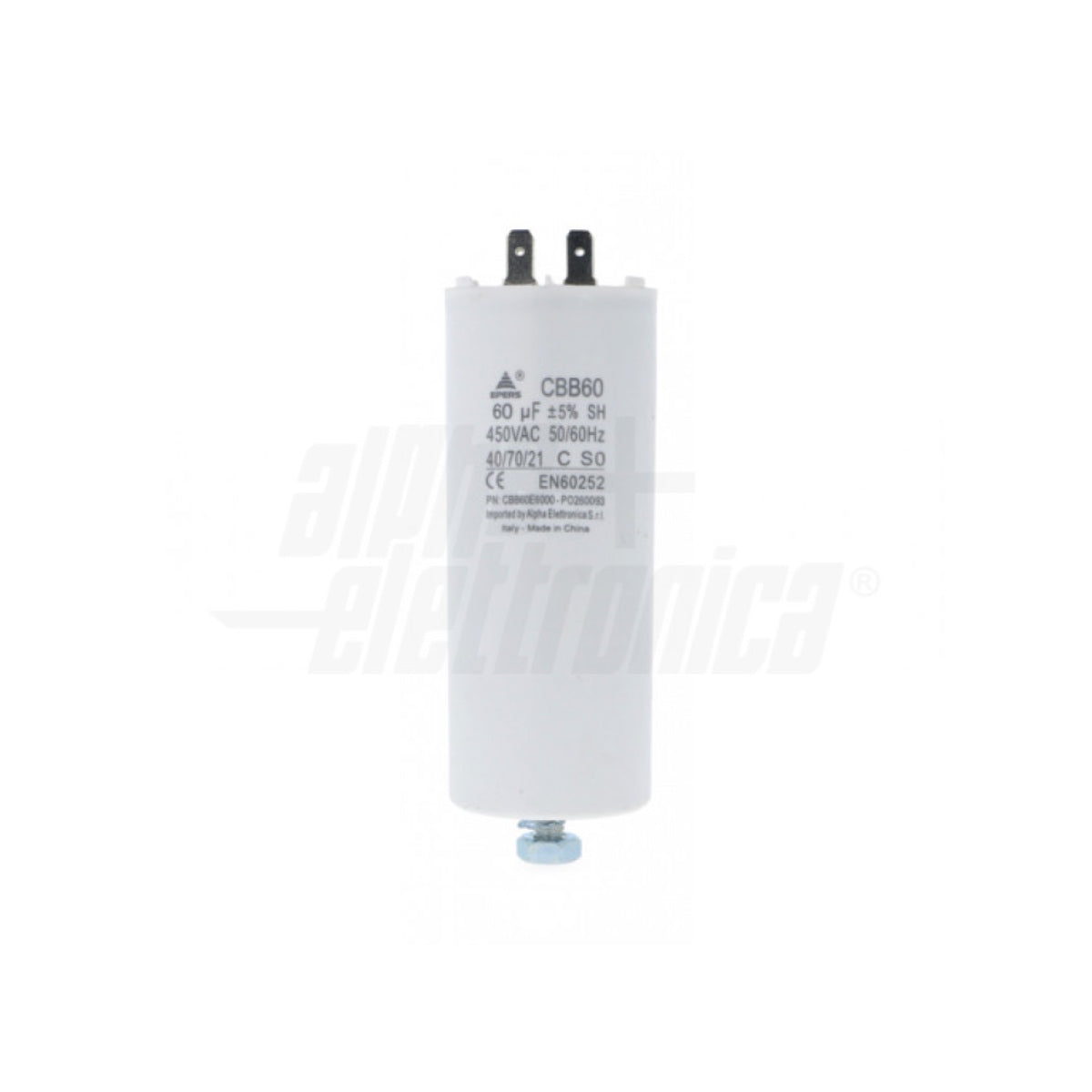
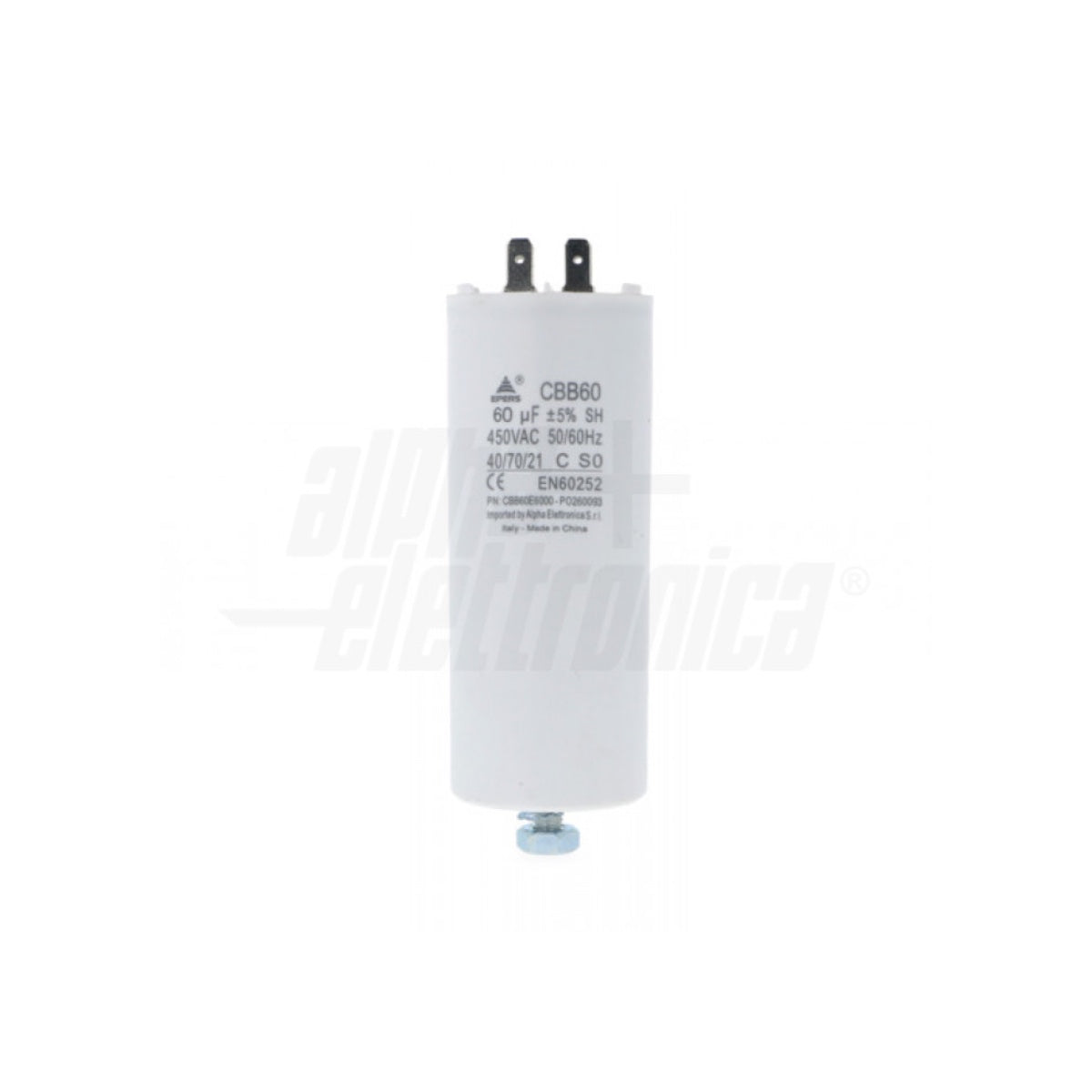
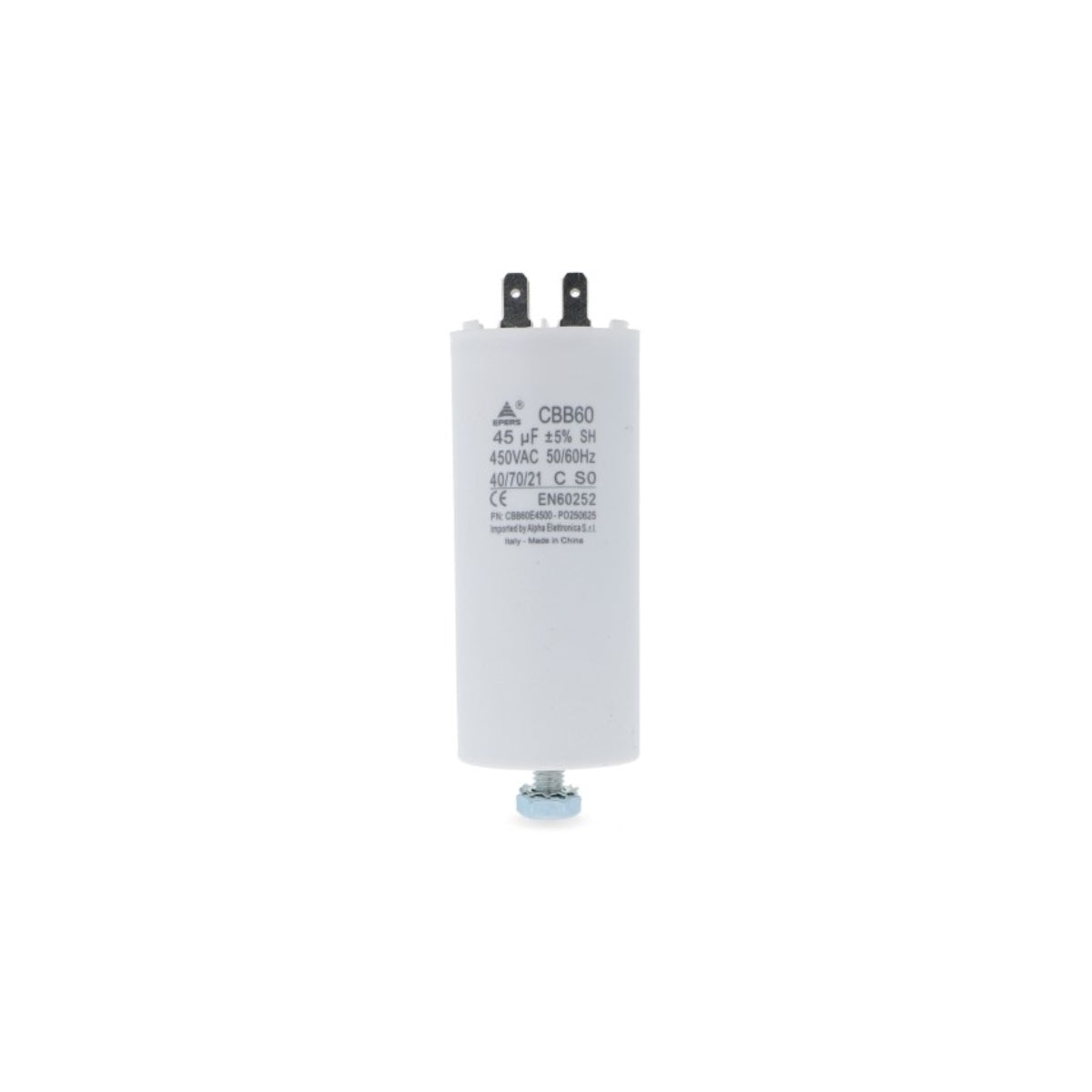
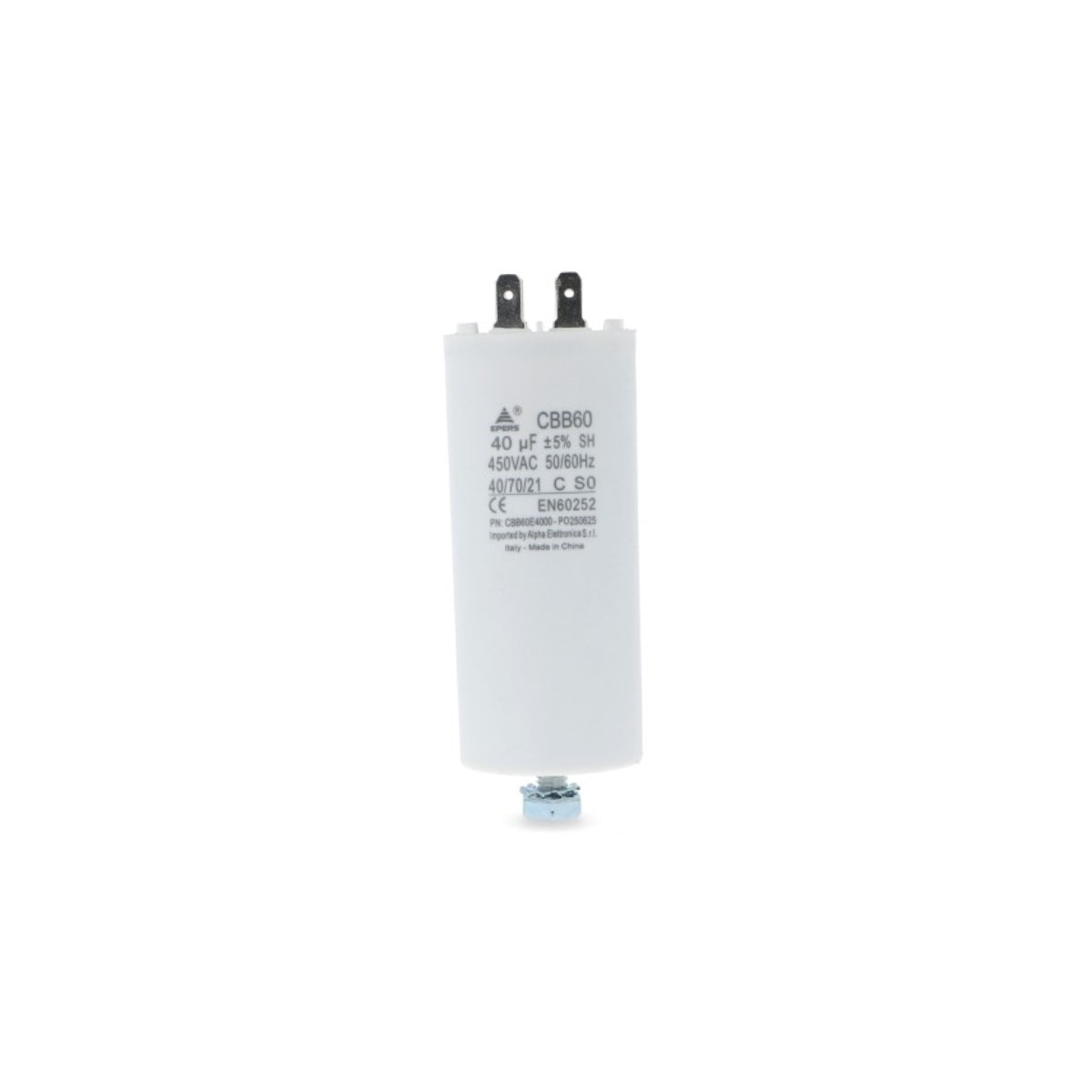
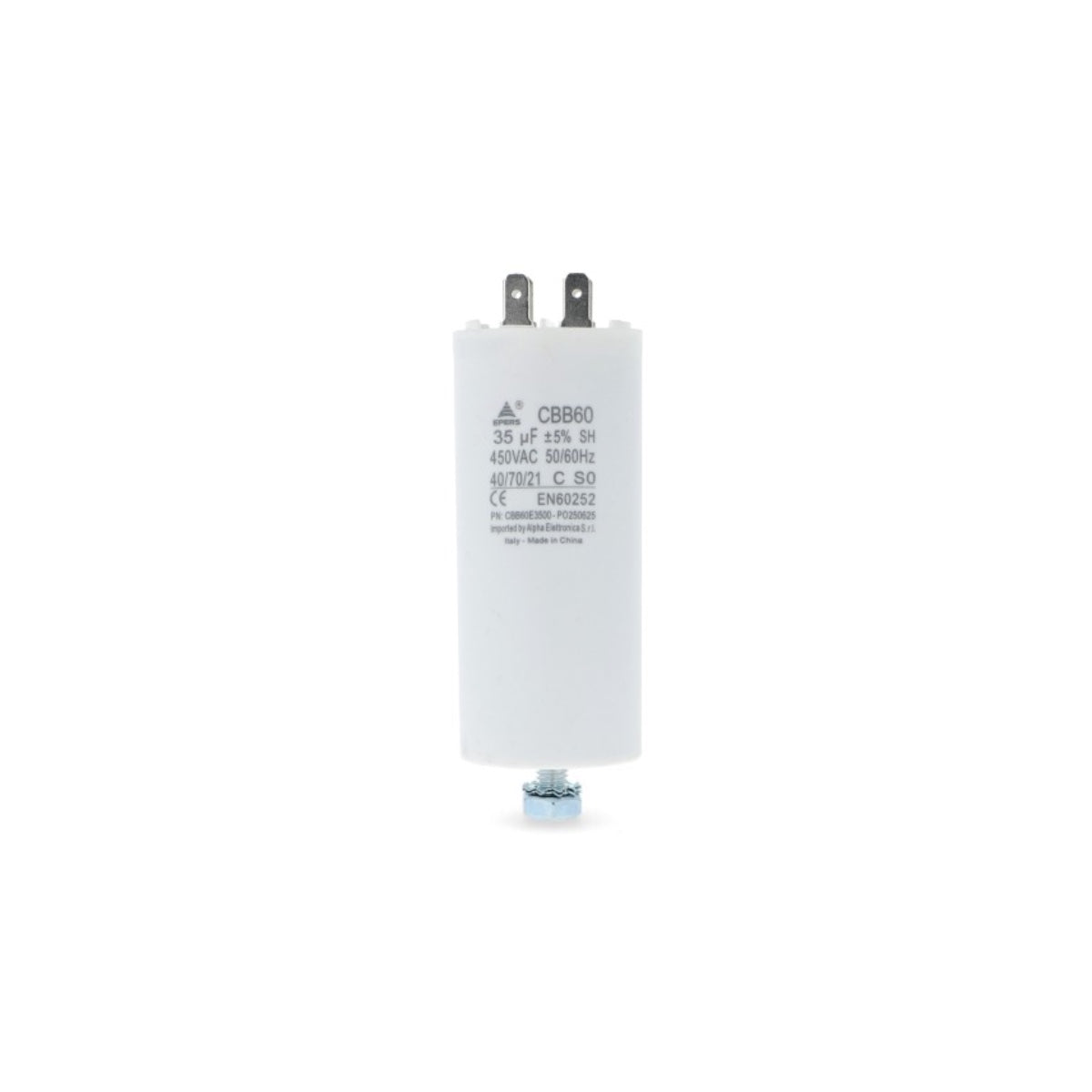
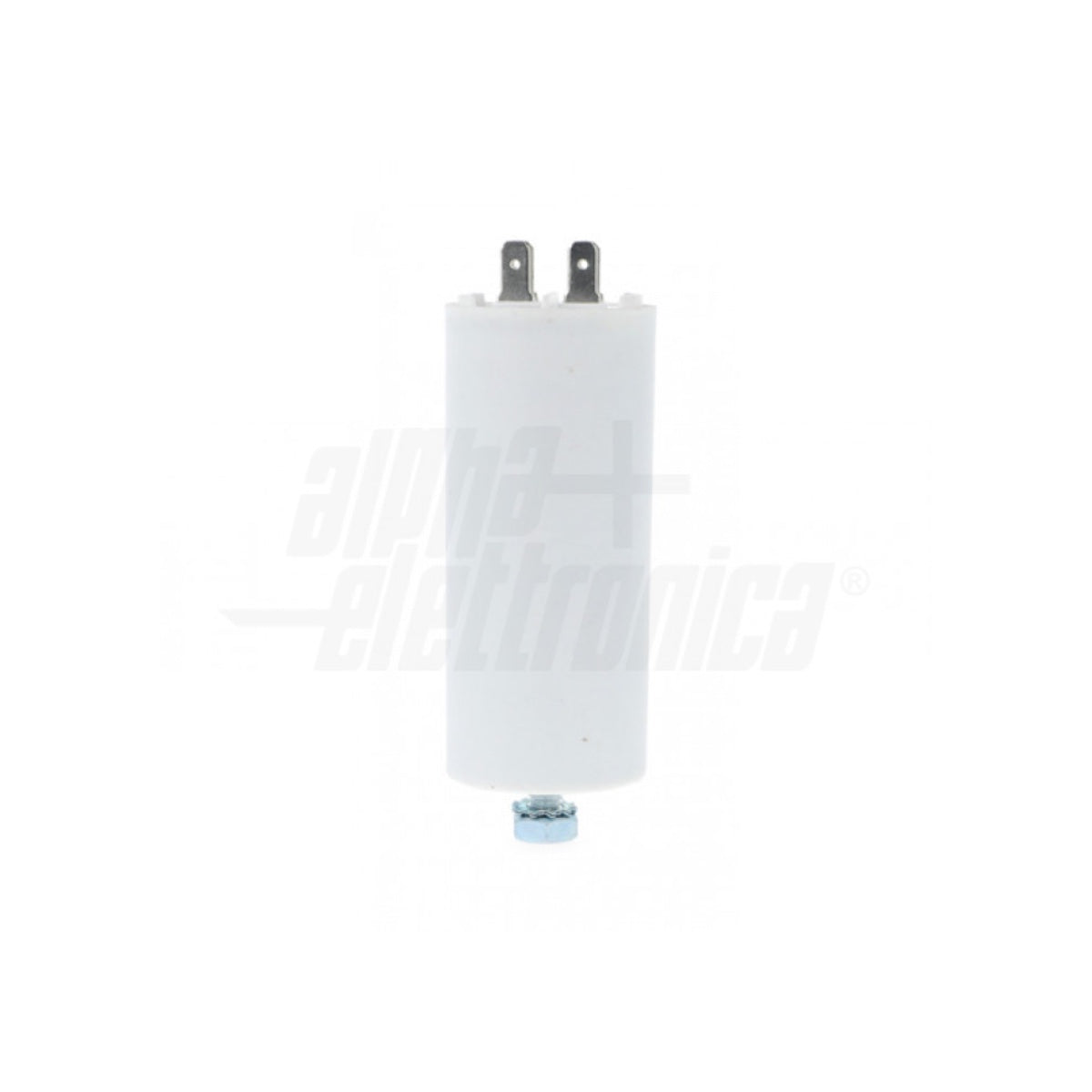


Single-phase Motor Capacitors — CBB60 and CBB61, 450 VAC
Here you will find run and start capacitors in 450 VAC metallized polypropylene for pumps, autoclaves, compressors, fans, HVAC motors, and automatic gates. Capacitance from 1 µF to 80 µF, ±5% tolerance, 3,000 hours service life. They directly replace the original factory-installed capacitors.
If your motor hums but doesn't start, or if the old capacitor has swollen, you are in the right place. Before choosing the size, read the guide — a 2 µF error on a single-phase motor can cause it to run with reduced torque or burn out.
Guide to choosing the right capacitor for a single-phase motor
Choosing the right capacitor for an electric motor is not about brand: it's about capacitance in µF, voltage, and terminal type. Getting one of these three parameters wrong means, at best, a motor that starts poorly; at worst, a burnt winding. This guide takes you from diagnosis to selection in a few steps.
Decision table — which capacitor do I need?
Use this table as a compass. The exact µF value is always found on the label of the faulty capacitor (not on the motor nameplate, which only shows power).
| Typical Application | Indicative Capacitance | Recommended Series | Notes |
|---|---|---|---|
| Circulation pumps, small fans, pedestrian gates | 1 – 4 µF | CBB61 (wires) or CBB60 (fastons) | Motors up to 0.18 kW (¼ HP) |
| Washing machines, split air conditioners, gate gearmotors | 5 – 16 µF | CBB60 | Run (permanent capacitor) |
| Autoclave pumps, fridge compressors, 0.55 – 0.75 kW motors | 20 – 30 µF | CBB60 | For 0.75 kW (1 HP) the typical value is 25 µF |
| Submersible pumps, air compressors, industrial motors ≥ 1 kW | 35 – 80 µF | CBB60 | Always check the original label |
| Start (starting) on heavy-duty starting motors | 50 – 80 µF (intermittent use) | CBB60 dual-use Start & Run | Works for a few seconds at startup |
⚠️ Radical Honesty — the mistake (almost) everyone makes
When a single-phase motor struggles to start or overheats, the instinct is to increase the µF of the capacitor "to give it more boost." This is the number one mistake we see in technical support. A larger capacitor does not make the motor more powerful: it causes more current to flow through the auxiliary winding, which heats up until it burns out. The difference isn't noticeable in 5 minutes, it's noticeable after 200 hours of operation.
The rule is simple: install the same µF value as the original, with ±5% tolerance. If the motor continues to start poorly with the correct value, the problem is not the capacitor — it's the winding, the bearing, or the impeller.
Technical specifications, explained simply
µF (microfarad): this is the "size" of the capacitor. More µF = more starting current. It should be chosen according to the motor, not arbitrarily. You'll find it on the old capacitor's label (e.g., "16 µF" or "16 MFD").
450 VAC: this is the maximum voltage the capacitor can withstand. All our products are 450 V and work on 230 V mains. Do not buy 250 V or 300 V capacitors "because they are cheaper": they will only last half as long.
Self-healing metallized polypropylene: the internal dielectric. In case of a localized discharge, it repairs itself (technically: it vaporizes the damaged area and insulates the fault). The difference from cheap electrolytic capacitors: the latter fail permanently at the first overload event.
±5% tolerance: indicates how much the actual capacitance can deviate from the declared one. Good quality CBB60/CBB61 products have ±5%, entry-level ones can be up to ±10%. On small capacitances (1–4 µF), the difference is noticeable in starting torque.
3,000 hours service life at 70°C: hours of continuous operation before the capacitance drops below the acceptable threshold. At lower temperatures, life significantly extends — a capacitor in a basement works better than one enclosed in a pump housing.
6.3 mm faston terminal (CBB60): the 4 blade terminals where the female connectors of the cables are inserted. This is the standard on Italian and European motors.
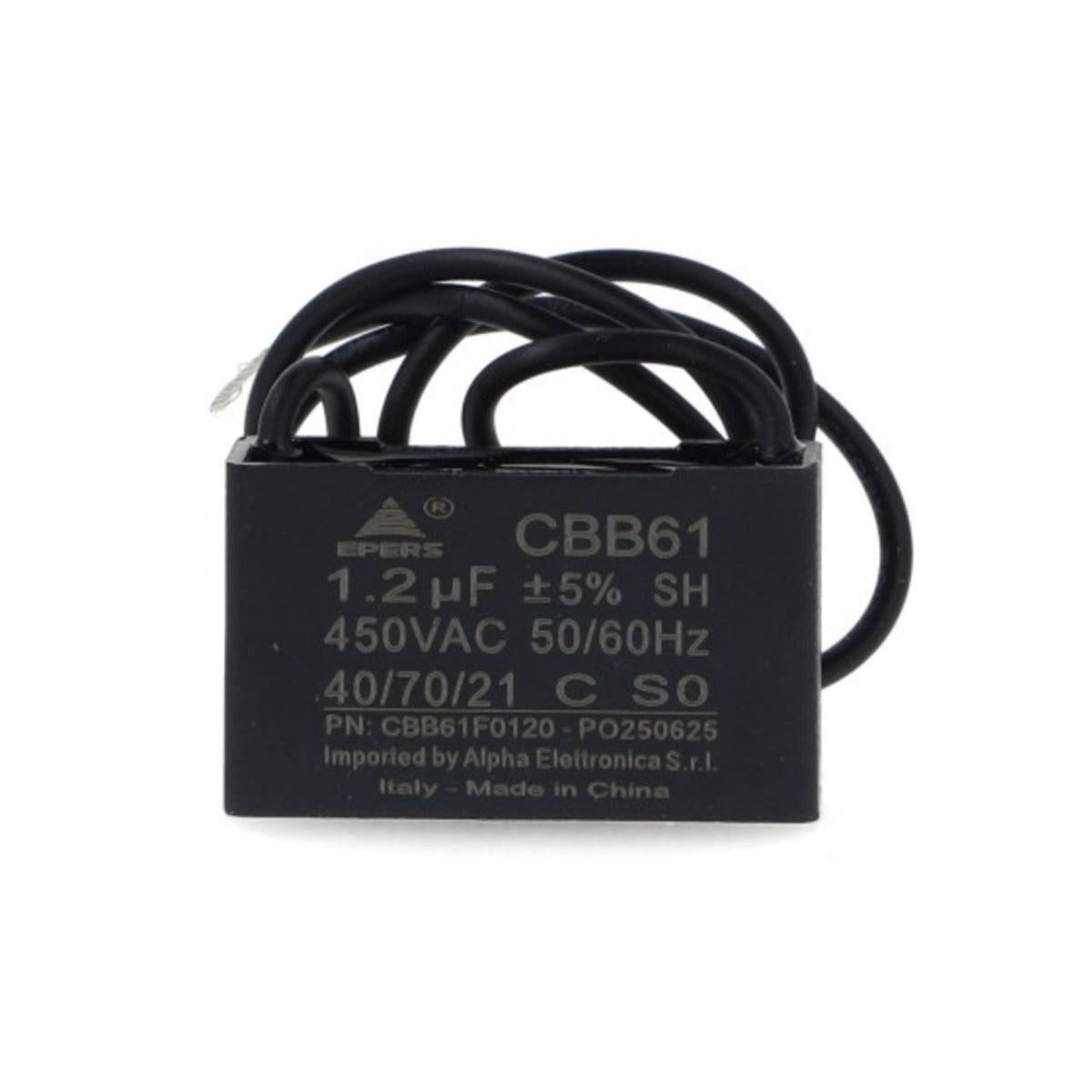
Wire terminals (CBB61): two pre-soldered and insulated wires coming out of the body. Used where there is no space for fastons, typically on household appliances and small ceiling fans.
M8 screw mounting (CBB60): the threaded stud under the cylindrical body, where you screw the mounting bracket. Without this, on a vibrating motor, the capacitor will break at the base within a few months.
Pre-purchase Checklist — 3 checks in 30 seconds
- ✅ Read the µF on the label of the OLD capacitor, not on the motor nameplate. The motor nameplate only indicates power (kW/HP), not the capacitor's capacitance.
- ✅ Check the terminal type: if the original cables ended with blade connectors → you need CBB60 (6.3 mm faston). If the cables came directly out of the capacitor → you need CBB61 (wires).
- ✅ Verify the voltage: 450 VAC is always suitable for the Italian 230 V mains. Do not go below 400 V even if you see cheaper products.
In doubt? Send us a photo of the faulty capacitor's label via WhatsApp or email: we'll confirm the replacement part before you order it. Better to ask than to return.
Frequently Asked Questions
How do you connect a capacitor to a 2-wire single-phase motor?
On a 2-wire single-phase motor (typical for autoclave pumps), the two capacitor cables must be connected, one to the power supply phase and the other to the end of the auxiliary winding. In practice, the capacitor is in series with the starting winding and in parallel with the main winding. Before operating, disconnect the power supply and short-circuit the terminals of the old capacitor with an insulated screwdriver: even with the motor off, it can retain a residual charge.
What about a 4-wire single-phase motor?
On 4-wire motors (washing machines, gate gearmotors), both windings are accessible. The capacitor should be connected between the free end of the auxiliary winding and the common power supply phase. The 4 wires typically are: two ends of the main winding (power supply), two ends of the auxiliary (capacitor + phase). The exact wiring diagram is always printed on the terminal block or on the motor housing cover — do not rely on cable colors, as they vary by manufacturer.
Which capacitor is needed for a 0.75 kW (1 HP) single-phase motor?
For a 0.75 kW (1 HP) single-phase motor, the typical value is 25 µF at 450 VAC, but it can vary between 20 and 30 µF depending on the manufacturer and the type of load (pump, compressor, fan). The absolute rule is always the same: read the label of the original capacitor before purchasing the replacement. The "µF/kW calculation tables" circulating online are indicative — manufacturers size based on the required torque profile, not just power.
Are CBB60 and CBB61 interchangeable?
Electrically yes, for the same µF and voltage they do the same job. The difference is mechanical: CBB60 has 6.3 mm faston terminals and an M8 mounting screw, CBB61 has pre-soldered wires and front bracket mounting. If the original was a CBB60 and you want to install a CBB61 (or vice versa), you need to adapt the wiring and mounting bracket. Generally, replace with the same series to avoid modifications.
How long does a CBB60 or CBB61 capacitor last?
The declared service life is 3,000 hours at 70°C, a standard value for 450 V polypropylene capacitors. In practice, in a typical residential application (autoclave pump used a few hours a day), this means 7-10 years of service. Conditions that shorten life are high ambient temperature, continuous vibrations, and mains overvoltages. A capacitor that swells or leaks oil from the end should be replaced immediately, without waiting for failure.